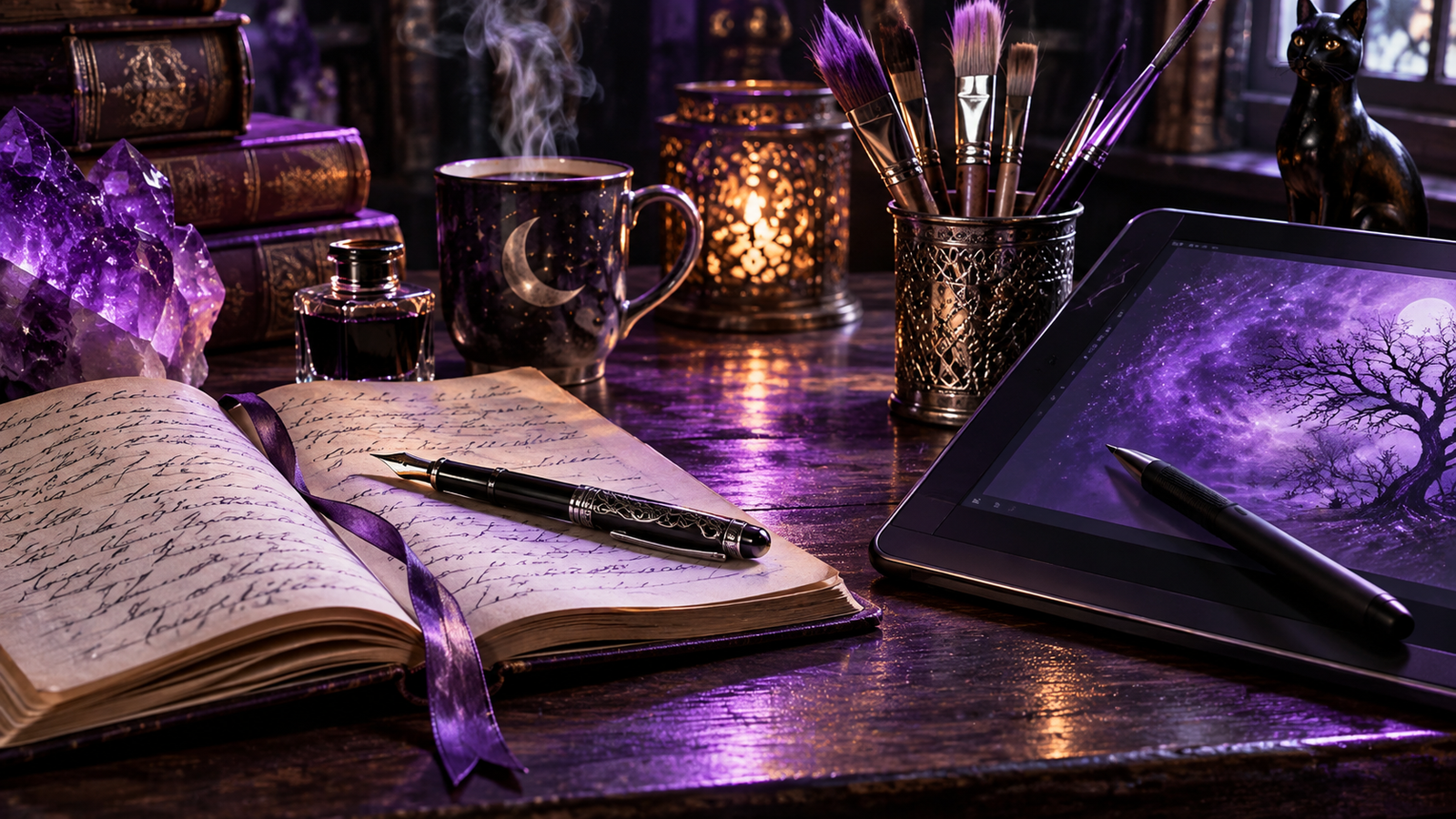

There has always been a certain fascination with the tools artists use. We admire the painter’s brushwork, the photographer’s ability to manipulate light and the musician’s command of an instrument. Yet somewhere between the invention of the camera and the emergence of artificial intelligence, our relationship with creative tools became increasingly complicated.
Technology has introduced an uncomfortable question: how much of the creative process must a person perform personally before the resulting work can be considered their own?
Creativity Begins Before the Tool
A blank canvas, an empty document and a silent recording studio all have something in common. None possesses an intention of its own.
The creative process begins with an idea, an emotion or an observation. Sometimes it begins with something considerably less defined—a feeling that has not yet found the appropriate language or form.
Technology can help give that feeling shape. It can also introduce possibilities that an artist might not have considered independently. However, having access to those possibilities does not automatically make someone an artist. There is still a considerable difference between generating something and developing something meaningful.
The Freedom to Experiment
One of the most interesting aspects of modern technology is its ability to reduce the distance between imagination and execution.
A poet can explore music. A musician can experiment with visual storytelling. A novelist can develop imagery that captures the atmosphere of an imagined world. Creative people no longer need to confine themselves to a single medium simply because they lack formal training in another.
That freedom does not eliminate the value of traditional skills. Learning to paint, write, compose or perform remains worthwhile. Technology simply offers additional routes through which creative ideas can travel.
The existence of a new route does not require the abandonment of an old one.
Responsibility Remains Human
Creative freedom also comes with responsibility. Questions about originality, consent, attribution and transparency deserve serious consideration. Artists should be willing to acknowledge their processes without feeling obligated to diminish their contributions.
There is nothing inherently admirable about concealing the involvement of technology, just as there is nothing inherently shameful about using it.
What matters is how thoughtfully it is used, whether the rights of others are respected and whether the artist brings something distinctive to the finished work.
Beyond the Argument
Perhaps the most limiting aspect of the current debate is the assumption that traditional creativity and technological innovation must exist in opposition.
They do not.
An artist can appreciate the imperfections of handwritten poetry while embracing digital composition. A person can enjoy the texture of physical paint while exploring imagery through software. Creative identity need not be restricted to the methods available when that identity first began to develop.
The tools will continue to change. Some will disappear, while others will become so familiar that future generations will wonder why they were ever controversial.
The more enduring question is not which tools an artist chooses, but what that artist has to say.
Technology may influence the way a creative voice reaches the world, but the pursuit of meaning remains a profoundly human endeavor.


Leave a Reply
You must be logged in to post a comment.